Sunday, March 16, 2014

Most Anticipated Teen Books: Spring 2014

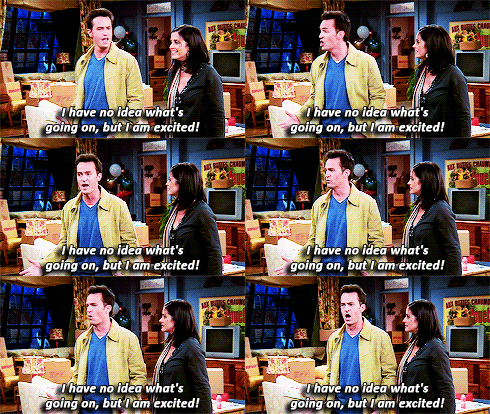
Spring has come! (Thank goodness.)This crop of YA releases is heavy on series finales (three!), but otherwise it’s a mix of new and established authors with settings that range from an alternate nineteenth century British Empire to Soviet Russia to modern-day, fantasy-drenched Prague. I can’t wait for each and every one!
 

April 1
Sekret—Lindsay Smith

What it’s about: Yulia's father always taught her to hide her thoughts and control her emotions to survive the harsh realities of Soviet Russia. But when she's captured by the KGB and forced to work as a psychic spy with a mission to undermine the U.S. space program, she's thrust into a world of suspicion, deceit and horrifying power. Yulia quickly realizes she can trust no one and must rely on her own wits and skills to survive in this world where no SEKRET can stay hidden for long.

Why I’m excited: Soviet Russia. KGB. Psychic spy. U.S. space program. From the description (even just those key words) I can tell this has potential to be a great historical and political thriller. Yulia sounds like a strong girl and I’m excited to dive into her unique story.


April 8
Dreams of Gods and Monsters—Laini Taylor

What it’s about: In the conclusion to the Daughter of Smoke & Bone trilogy, Karou is still not ready to forgive Akiva for killing the only family she's ever known. When a brutal angel army trespasses into the human world, Karou and Akiva must ally their enemy armies against the threat--and against larger dangers that loom on the horizon. They begin to hope that it might forge a way forward for their people. And, perhaps, for themselves--maybe even toward love.

Why I’m excited: This series is one of the most imaginative modern-day YA fantasies I’ve read. I’ve been impatiently waiting for the third and final book in the series for over a year, and I can’t wait to revisit Karou and Akiva’s exhilarating yet tortured romance. Plus, angels. And monsters.


The Summer I Saved the World… in 65 Days—Michele Weber Hurwitz

What it’s about: It's summertime and thirteen-year-old Nina Ross is feeling lost. Her beloved grandma died last year, her parents work all the time, her brother's busy and her best friend’s into clothes, makeup and boys. Nina doesn't know what "her thing" is yet so she decides to mix things up. Every day this summer, she'll anonymously do one small but remarkable good deed for someone in her neighborhood in an effort to find out: does doing good actually make a difference?

Why I’m excited: Because every now and then I need a feel-good summer tale. Hopefully with a heartfelt, light romance and an abundance of inspiration. This release sounds like it will fit perfectly, so I'm excited to relax a little with Nina's story and breathe in the scent of summer.


April 22
The Inventor’s Secret—Andrea Cremer

What it’s about: In an alternate nineteenth-century North America, sixteen-year-old Charlotte and her fellow refugees have scraped out an existence on the edge of Britain’s industrial empire. Though they live by the skin of their teeth, they have their health (when they can find enough food) and each other. When a new exile with no memory of his escape or even his own name seeks shelter in their camp, he brings new dangers with him.

Why I’m excited: Steampunk. By Andrea Cremer. That pretty much sums up my excitement, but the concept is fantastic as well. The setting is an alternate nineteenth-century North America where there was no Revolutionary War and the British Empire is a global force of majestic and horrible machinery. WHOA.


She is Not Invisible—Marcus Sedgwick

What it’s about: Laureth Peak's father has taught her to look for recurring events, patterns, and numbers—a skill at which she's remarkably talented. Her secret: She is blind. But when her father goes missing, Laureth and her 7-year-old brother Benjamin are thrust into a mystery that takes them to New York City where surviving will take all her skill at spotting the amazing, shocking, and sometimes dangerous connections in a world full of darkness.

Why I’m excited: Because Sedgwick just won the Printz Award for Midwinterblood (which is on my to-read shortlist), and this is his first release since that honor. The description is vague but intriguing, and I imagine this book will be a mysterious, intelligent read with an interesting perspective.


May 6
The One—Kiera Cass

What it’s about: The Selection changed America Singer's life in ways she never could have imagined. Since she entered the competition to become the next princess of Illéa, America has struggled with her feelings for her first love, Aspen—and her growing attraction to Prince Maxon. Now she's made her choice and she's prepared to fight for the future she wants.

Why I’m excited: Because I need to know if America picks Aspen or Maxon! (Sometimes I’m such a fangirl.) Anyway, this series is an interesting mix of dystopia and The Bachelor, which is why it’s so intriguing. The first two books in the series tugged my heart strings and were an unexpected surprise, so I’m hoping for the same from the conclusion of the trilogy.


May 27
Allies & Assassins—Justin Somper

What it’s about: Prince Anders, the ruler of Archenfield, has been murdered, leaving his younger brother, Jared, to ascend the throne. Sixteen-year-old Jared feels unprepared to rule the kingdom and its powerful and dangerous court, yet he knows he can rely on the twelve officers of the court to advise him. He also knows he can be at their mercy-especially when one of them may be responsible for his brother's death. Unable to trust anyone, Jared takes it upon himself to hunt down his brother's killer-but the killer may be hunting him, as well.

Why I’m excited: Because high fantasy YA with princes and assassins and uncertain loyalties? That basically screams my name. In the interest of full disclosure, I am currently in possession of the DRC (digital review copy) of this novel. I just started it, but am already intrigued by the multiple perspectives and the intricate mystery.


June 17
Ruin and Rising—Leigh Bardugo

What it’s about: The capital has fallen. The Darkling rules Ravka from his shadow throne. Now the nation's fate rests with a broken Sun Summoner, a disgraced tracker and the shattered remnants of a once-great magical army. A weakened Alina will have to forge new alliances and put aside old rivalries as she and Mal race to find the last of Morozova's amplifiers. As she begins to unravel the Darkling's secrets, she reveals a past that will forever alter her understanding of the bond they share and the power she wields.

Why I’m excited: Because this series is expertly written and plotted. I read the first two last summer, and they were simply unputdownable. I imagine this series finale will be the same, if not better. And I’m not at all worried that my high expectations will go unmet.
 

Are any of these spring releases on your to-read list?


*Book descriptions were adapted from those on BN.com.

Sunday, March 9, 2014

The Mysterious YA Mystery

I’m a bookseller. (If you didn’t already know.) Customers regularly ask for YA dystopia, YA romance and YA fantasy recommendations, and I know just want to suggest. Twice now, I’ve been asked for YA mysteries. YA mysteries?! What are those? I’m sure they exist. In fact, I know I’ve read some. But there’s no easy answer. There’s no section or table or display (at least in any bookstore I’ve been to). So, what YA books are mysterious? Here are my suggestions:
 

Death Cloud – Andrew Lane

Gallagher Girls series – Ally Carter

Heist Society series– Ally Carter
Kat Bishop is a thief, as are all her friends and family. After leaving the family business for a normal high school existence, she’s pulled back in when her father is named the only suspect after a mobster's art collection is stolen. Kat has two weeks to pull off the biggest heist in her family’s history, and steal her life back along the way. In this series, we follow Kat, Hale and other teenage talents through their cons, but the reader doesn’t learn how they did it until the end, leaving the mystery open so readers can attempt to solve it along the way.


Pretty Little Liars series – Sara Shepard

Shelter – Harlen Coben
Mickey’s year is off to an awful start after he witnesses his father’s death, sends his mom to rehab and is forced to live with his estranged uncle Myron. Then, his new (girl)friend, Ashley, vanishes. Following her trail into the underworld reveals Ashley isn’t who she claimed to be. Soon Mickey learns about a conspiracy that leaves him questioning everything. Coben writes adult mystery novels, but ventured into the mindset of his main characters nephew for this classic mystery YA tale.


Stormbreaker series- Anthony Horowitz

The Body Finder – Kimberly Derting

The Book of Blood and Shadow – Robin Wasserman

The Diviners – Libba Bray

The Face on the Milk Carton series– Caroline B. Cooney
She’d never paid close attention to the missing children on milk cartons, until she saw the face of an ordinary girl with pigtails who had been kidnapped twelve years before in New Jersey. Janie Johnson is shocked to realize that girl is her. Did her loving parents kidnap her? As she searches for clues, she realizes nothing makes sense. And Janie will stop at nothing to find out her real identity. This is a suspenseful tale that's (so far) stood the test of time for a YA novel, as it was originally published in 1990.


The Liar Society – Lisa Roecker

The Lying Game – Sara Shepard

The Name of the Star series - Maureen Johnson
The same day Rory arrived at boarding school in London was also the day a series of brutal murders reminiscent of Jack the Ripper broke out across the city. The police have few leads and no witnesses, until Rory spots a man now believed to be the prime suspect. But she's the only one who saw him, and she quickly becomes his next target. The Name of the Star begins a thrilling series by Maureen Johnson with elements of mystery, paranormal and romance.


The Naturals – Jennifer Lynn Barnes

Unspoken – Sarah Rees Brennan

What I Saw and How I Lied – Judy Blundell
When Evie’s father returned home from World War II, the family fell back into its normal life quickly. But soon Evie realizes her father brought back more than just good war stories. Peter Coleridge, a young handsome ex-GI who served in her father’s company in postwar Austria, shows up and Evie is caught in a complicated web of lies only she recognizes. She finds herself falling for Peter and ignoring his secrets until a tragedy occurs that shatters her family and her life. This novel leans more toward historical thriller than mystery, but it has a classic-type feel in its engrossing, creative descriptions.


Are there any YA mysteries I missed? Let me know in the comments!


*Book descriptions were adapted from those on BN.com.

Sunday, March 2, 2014

If JK Rowling cares about writing, she should write.

Beware, this is a rant…

So this happened last week. I suggest you give it a read. Unless you’re in a really good mood right now and don’t want it spoiled.
I read the article last week when it was published. There are so many things wrong with it that I almost don’t know where to begin. Almost.

1)      It’s shameful to read Harry Potter if you’re an adult?!?!

a.       I can’t even.

b.      Okay, maybe I can. Here’s another adult who thinks kids books (MG) and YA books are “below” them just because the books are written for kids. The common denominator between the people who say this: they haven’t read it! Ms. Shepherd admits to not having read Harry Potter. Others have written about how adults shouldn’t read Twilight or romance but if they haven’t read it themselves, how can they even judge? 

2)      It implies writing for kids is inferior.

a.       Writing, reading. Potato, potato. (This works better when spoken.) See above.

3)      If you’re taking aim at JKR, why not take aim at Patterson or Connelly or Roberts or the dozen or so other authors who dominate bestsellers with every release?

a.      I know JKR is a kahuna, but seriously, Patterson releases a new book every month and it’s always on the bestsellers. If that’s not domination, I don’t know what is.

b.      Ms. Shepherd singles out an author who wrote for kids before writing for adults. She didn’t mention all the adult authors who dominate the bestsellers (see above) who now write for kids too. (Patterson, Coben, Grisham and more have books in the MG and/or YA sections.) It’s like allowing people from Village A to move to Village B but if anyone from Village B wants to move to Village A? Their welcome looks like this:
Source: Warner Brothers
4)      Maybe if Ms. Shepherd had read Harry Potter, she would feel differently.

a.       If you haven’t experienced the magic, then sure, judge it all you want. (Hint: SARCASM.)

5)      Also, what if this was just a fancy *cough* lowly *cough* way for Ms. Shepherd to get more sales for her books? Did we just see a twerking episode of the publishing industry?


People reading books is good for the publishing industry as a whole. (I mean, duh.) And JKR gets people to read, no matter if it’s Harry Potter or Cuckoo’s Calling. She makes it more likely for people to visit a bookstore and buy books. (As do Patterson, Connelly, Grisham and all those mentioned above.) This is good for publishing, for authors and for literacy.

I’m a 26 year old adult. I have a Harry Potter poster above my bookcases. Those bookcases are full of YA. I own children’s books and adult books too. I’ve even read some of them.

I know YA is for me, but I’m not about to degrade or judge someone who reads MG or mystery or true crime or biographies or adult fiction or romance. So I’d appreciate it if people who prefer other genres didn’t do that to MG and YA readers.

Yes, I love YA. But most importantly, I LOVE BOOKS.

And no one I MEAN NO ONE tells JK Rowling to stop writing.

(See what I did there?)

/rant

Sunday, February 23, 2014

Why Writing is Hard

I bet many of you are thinking DUH. However, it’s possible not all of you agree, which is why this needs to be said. Writing is hard. It’s downright difficult. If it’s easy, then you’re doing it wrong.


Books are long
Books are hundreds of pages long. They're hard to keep track of in my head, even if I'm just reading them! I struggle every day with the structure and organization of my story. It’s hard to remember what happened in chapter 12 to such-and-such character in the conservatory with the candlestick. And why they need to be in the ballroom in chapter 13, dancing with the wrench. Wait… I may have confused my plotline with the classic board game Clue.

It's like this.


There are a lot of words
Google is giving me conflicting results on how many words there are in the English language, but it looks like it’s almost 200,000. That’s a lot of words to choose from when writing. What if something isn’t just great? What if it's exceptional or splendid or fantastic or extraordinary?! How am I supposed to choose the right degree of awesome? Also, it occurs to me that the word count goal for my novel is 75,000. That’s less than half of the words that are available to choose from. Le sigh.


Anything can happen
Literally. I could have my character jump off a cliff, find a hidden world in a tree truck or meet Doctor Who (well, that would probably be against some kind of copyright law). But seriously, I can make anything happen while writing, within reason. And sometime outside reason. That gives me an extraordinary number of potential plot fails. So finding the “right” plot for my characters? Not easy.


So, writing is hard. But, I do it anyway.

Because I like making things up. I like creating worlds that are my own, with my own form of fantasy and insanity. I like my characters, who sometimes do what I say and occasionally act on their own (you’d think that’d be frightening but it’s actually kind of cool). I enjoy frolicking in the fields of my own imagination.

So even though books are long, even though there are thousands of words to choose from and even though there are an endless number of beginnings, middles and ends, I write. It’s difficult, but I love it anyway. Or maybe I love it because it’s difficult.


Sunday, February 16, 2014

Interpreting Happily Ever After

And they lived happily ever after… or maybe they didn’t. Maybe they broke up in a fiery fight a month or year later. Maybe there were curse words and flying objects. Maybe there was couples’ counseling.

OH WAIT.

As readers, we like to believe that certain fictional couples—our favorites usually—stay together forever. I like to believe that Katniss and Peeta, Ron and Hermione, Harry and Ginny, Cath and Levi, Etienne and Anna all lived “happily ever after.” Or that they lived together, and worked every day on their relationships.

Some YA authors don’t give their couples a “happily ever after” and I understand why. Teens are young. Who finds their soulmate in high school? Okay so I know a few couples, but mostly, no. These young couples are still growing, still changing, maybe one or both aren’t ready for a long-term relationship or maybe they don’t know each other that well.

As it turns out, even if characters are together in a flash-forward epilogue, it doesn’t mean they live happily. I did relish Ron and Hermione’s get-married-have-children-send-them-off-to-Hogwarts-a-dozen-years-later ending. The “happily ever after” I imagined for them changed with Emma Watson’s interview with Rowling. I realize now that Ron and Hermione might have needed couples’ counseling. Maybe (even though it pains me to admit this) Hermione would have been happier with Harry or someone else entirely. But Rowling didn’t leave the Deathly Hallows epilogue open for interpretation. That ending is unchangeable.

(I take solace in the fact that no matter how many people that interview reaches, it will never be able to reach as many people as the books have.)

Seven years ago, people disliked the resolute nature of the Deathly Hallows epilogue. Now, this revelation has readers fired up again. However, I’ve also seen readers criticize authors that leave endings open for interpretation. Even though it’s not right that it’s a lose-lose situation, it’s the nature of writing beloved characters.

It's my opinion that no matter how a story ends, I can imagine the ending any way I like. Authors can’t take away my imagined ending, whether it was mirrored in text or not. In the end, books belong to their readers.*

So, I imagine Ron and Hermione together, living mostly happily. They may argue on a semi-regular basis and they may need an occasional trip to counseling. But they love each other. It’s not a romantic life, but it’s realistic. And it’s my interpretation.
 
What's your interpretation of Ron and Hermione's happily ever after? What about any favorite YA couples?


*John Green said this, but I imagine others have as well.  

Sunday, February 9, 2014

Three Traits I Require to Love Fictional Characters

I’m not on board with all fandoms. I don’t LOVE every YA book I read. (Though I do like quite a lot.) When I read a book or watch a TV show/movie, there are three things I’m looking for. If these three things are well-done and if they are all there, it can nearly guarantee my love for the characters.
 
Charisma
They need to be likable. I need to be drawn to them. I need to be unable to stop reading or watching their stories. They are intelligent and courageous. They are revolutionaries. Protectors. Individuals. They are good. (Though not necessarily wholesome.)


Chemistry
They have chemistry with their friends, companions and/or lovers. Real, strong relationships. Like Sherlock and John or the Doctor and his companions. Heroes find people to complement them and to keep them sane and laughing. Because where would Katniss be without Peeta’s good heart? Where would Harry be without Ron and Hermione?


Quirkiness
They’re weird. Which makes it okay for me to be weird.
 
Okay really just any excuse to use this picture.
(Not that I would visit Buckingham Palace wrapped in a sheet.)

 
Bowties are cool.


Sunday, February 2, 2014

This Post is not about Dying, but about Living

Death is not convenient. Loss is not easy. As humans, we wouldn’t want it the other way around. We want to feel connections wholly, even if it means there will be emptiness when we lose someone.

Lose. A nuance of the English language. To lose someone, like they took a wrong turn on the way home from the grocery, or simply got separated in a crowd.

Maybe we use that word because the other one is too difficult to say. We’d rather not admit it to ourselves, let alone to others. Of course, maybe there’s also an innate hope that the loss is not irretrievable. That it can be reversed. That the person can be found again, someday.

In a time when I am experiencing loss, it occurred to me to make a list of YA books with themes of dying. The first book that popped into mind was The Fault in Our Stars. But then I remembered that somewhere, sometime, I heard someone (maybe John Green?) describe The Fault in Our Stars as a book that isn’t about dying, but about living.

Which sounds happier, more optimistic and all around better. Especially to me, right now.

So here are four YA novels, that aren’t about dying, but about LIVING:


If I Stay - Gayle Forman

In this hovering-at-the-edge tale, Mia chooses between life and death after a fatal accident claims her parents’ lives. When I finished If I Stay, I was reminded that every day we choose whether to live or die. It takes courage to make that choice. And courage to decide the extent to which we fulfill it.


The Sky is Everywhere - Jandy Nelson

When Lennie’s older sister dies abruptly, Lennie is catapulted from the shadows to center stage of her own life. Upon finishing The Sky is Everywhere, I was reminded that it takes time to accept loss. It’s not something we come to terms with overnight. Losing someone affects us; it affects our decisions and how we view the world around us.


The Spectacular Now - Tim Tharp

When life-of-the-party Sutter meets social disaster Aimee, he takes it upon himself to show her how to live in the now. Of course, it doesn’t turn out how either of them expected. When it comes to The Spectacular Now, it’s really all in the name. It’s another way of saying: live in the moment. You can fret about the past and prepare for the future, but how you live in the present is life. It is being alive.


The Fault in Our Stars - John Green

Hazel Grace Lancaster is terminal, but when she meets Augustus Waters at a cancer support group, their heartwarming love leads their stories to be rewritten. When I set down The Fault in Our Stars, I stood up. I got in my car, picked up my boyfriend and drove to one of the settings mentioned in the book. TFIOS is that inspiring. It made me want to live. Right away.

The movie trailer, released this week, might give you some idea as to its power.


Okay, this got a little bit COMPLETELY DRENCHED in clichés. Sorry. #notsorry

But just one more, before I go: Live a life worth living.


This post is dedicated to my beautiful, strong grandmother, who passed away Friday after a long and joyous life.