Friday, August 31, 2012

Lessons from the Storyman

Earlier this week, award-winning author Neal Shusterman visited the local Barnes & Noble for a reading, discussion and signing. Shusterman explained the story of Unwind and read three excerpts from his newest release, Unwholly, which I highly recommend. Throughout the discussion, I noted some important lessons for an aspiring author such as myself.


Be a Genre Breaker
Unwind and its sequel Unwholly can easily be classified as dystopian. When Shusterman was questioned about the genre and his opinion, he was visibly unfavorable. Not that he disapproves of the dystopian genre, but that he sees his books outside of a genre classification, and even outside of an age classification. Dystopian is currently a popular genre, but when it’s no longer on the forefront of public consciousness, the books within that genre might go by the wayside. Shusterman’s books are meant for not only those that enjoy dystopia but also those that enjoy adventure, science fiction, thrillers, teen and adult fiction. In essence, it’s a genre breaker. It’s not meant for just one classification, or just one set of people. So when writing, one shouldn’t strain to write within one genre, because sometimes the best books can’t be labeled.

Let the Character Lead
When Shusterman writes, he asks questions of his characters to discover their emotional paths. After formulating emotional arches for each character, then he begins putting words to paper. However, when writing, sometimes the character will react differently or more truthfully than they did in the original outline. If something no longer makes sense, if the character’s reaction is no longer genuine, then it’s time to adapt. Holding to the original outline can diminish your writing, as good ideas can fall to the page before the author realizes what’s happening. Don’t be afraid to adapt, and to let your characters lead.

Not taking sides can further your story
The concept of Unwind is based in the controversial issue of abortion. Years before the book takes place, the Second Civil War was fought between the pro-choice and pro-life camps. To end the war, a law was enacted which abolished abortion, but allowed parents to “unwind” children between 13 and 18 years of age. Since unwinding re-used nearly 100% of the body’s parts, it was not considered murder and therefore was legal. In Unwind, Shusterman does not take a stance on abortion, but merely tells a story of what happens in this futuristic fiction world. In not taking sides, he broadens the appeal and the reception of the book, and does not alienate readers. He shows the effects of such a law but does so through his characters stories. The author’s opinion is blissfully unknown, which makes the message—one concerning the fictional act of “unwinding” more so than abortion—resonate with readers.   

If you want to kill all your characters, it might be time to take a break
“And then everyone jumps off a cliff and falls to their death.” If you ever have the desire to write that on the next page of your story, then it’s likely that you are a little worn. And it’s probably time for you to take a break. When asked about his writing habits, Shusterman said that he can go back and forth to and from different projects, depending on what needs to be done and when he needs a break. Returning to a project a day, or week or even months later will bring a new perspective and renewed energy. So don’t be weary of setting a piece aside and return to it when the inspiration is flowing, or at least when you’re ready to make some (less homicidal) words appear on the screen again.
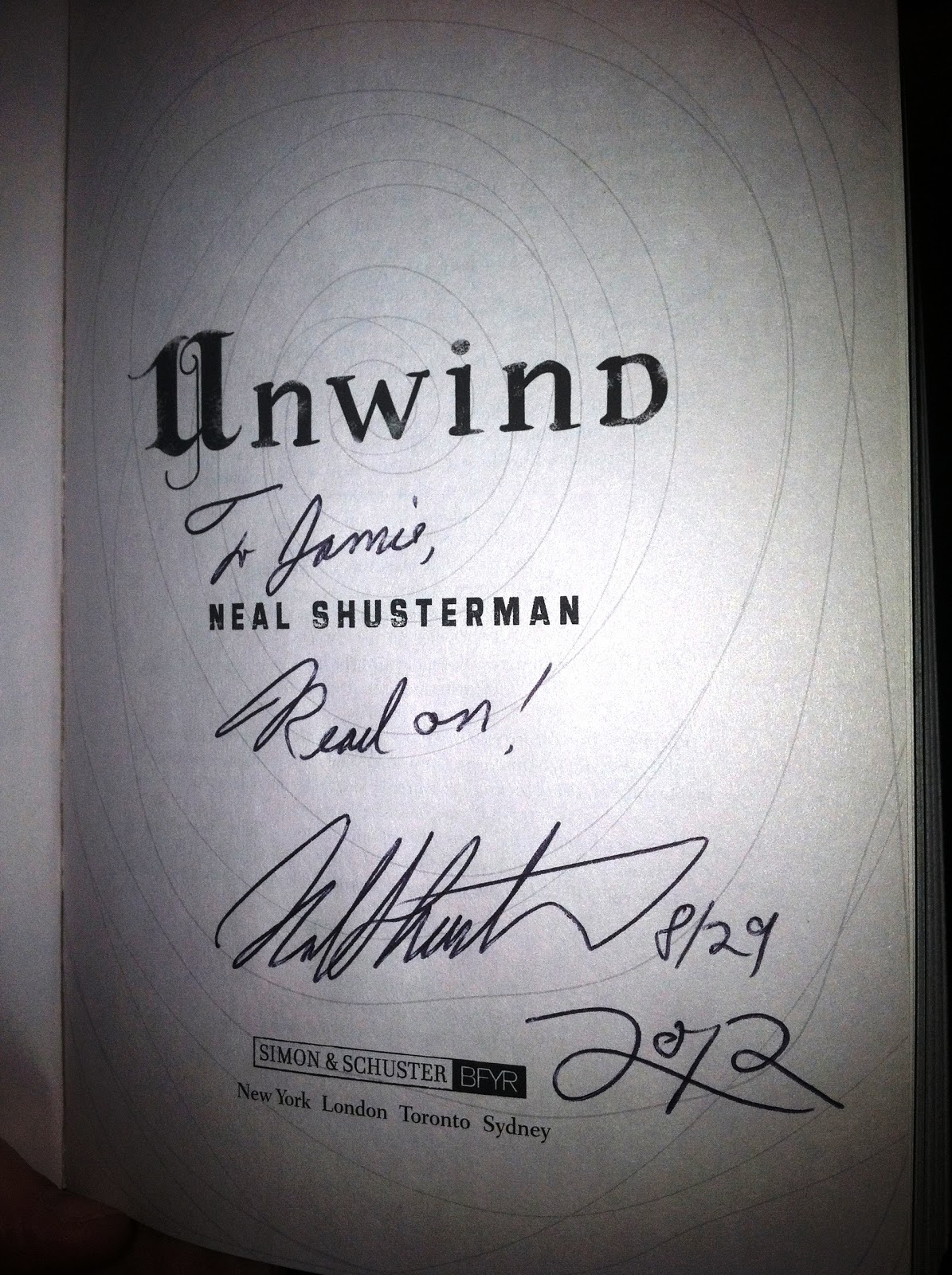


Thank you, Mr. Shusterman for visiting Indiana for the release of your outstanding sequel, Unwholly. Can’t wait for the third and final book in this trilogy!


DISCLAIMER: This post in an unofficial account of the event with Neal Shusterman on August 29, 2012 at the Barnes & Noble in Greenwood, IN. The views that I present in this article are my interpretations of the event. They do not necessarily represent the opinions of Neal Shusterman, Simon and Schuster or any affiliates.

Saturday, August 25, 2012

The Rise of Dystopia

-or- if you like the Hunger Games

As we approach the fourth anniversary of the Hunger Games publication, the rise in popularity of the dystopian genre has never been more evident. The teen section has been overcome with dystopian-themed novels, such as Veronica Roth’s Divergent and Ally Condie’s Matched. These novels and more have been gobbled up by teens—once they set down the Hunger Games, they are ready for another dystopian teen novel. According to the Telegraph the week before the Hunger Games movie release, “with the arrival of the film of the first book of Suzanne Collins’s best-selling trilogy the Hunger Games this month, dystopia for teenagers has hit an all-time high in public consciousness.” Publishers have been meeting these demands with the release of dozens of well-publicized dystopian teen novels over the past four years since the Hunger Games rocketed into popular culture.
                The authors that are following Collins in publication may not have been influenced in their writing of a dystopian novel. However, with the success of the Hunger Games, agents, editors and publishers have been more open to dystopian fiction as it is “the hottest genre in publishing and film on both sides of the Atlantic”. So it’s likely that the new teen dystopian releases were influenced by Collins’ Hunger Games in their publishing.  
 
History of Dystopia
The first novels that can be classified as dystopian were published over a century ago, but the genre has only enjoyed its rise in popularity since the release of the Hunger Games in 2008. This modern classic was preceded in the genre by such literary greats as Brave New World (1934), 1984 (1949) and Fahrenheit 451 (1953).
More recently, children’s authors have broadened the genre with such releases as the Newbury-award winning The Giver (1993) and Ender’s Game (1985), a science fiction yet dystopian classic takes the genre back to its original roots in science fiction.
In 2005, Scott Westerfeld published Uglies, the first of four in a dystopian teen series which became a turning point for the genre. Traditionally, dystopian novels were penned by men for men, but “Uglies was a strikingly new, dark tale which girls took to their hearts in droves.” Since that point, the teen dystopian genre has been driven by female characters and has seen an ever increasing number of female authors. 

Decade of Dystopia (2002-2012)
Here is a look back at the past decade of teen dystopian releases. It’s difficult to include every teen novel with a dystopian theme published in the past decade, but this collection includes those of note, influence and those believed to stand the test of time.


Feed: M.T. Anderson, 2002

House of the Scorpion: Nancy Farmer, September 2002 

How I Live Now: Meg Rosoff, August 2004

Uglies: Scott Westerfeld, February 2005
Sequels: Pretties, Specials, Extras

Life as We Knew It: Susan Beth Pfeffer, October 2006
Sequels: The Dead and Gone, This World We Live In

Unwind: Neal Shusterman, 2007
Sequel: Unwholly

The Declaration: Gemma Malley, October 2007
Sequels: The Resistance, The Legacy

Gone: Michael Grant, June 2008
Sequels: Hunger, Lies, Plague, Fear

The Knife of Never Letting Go: Patrick Ness, May 2008
Sequels: The Ask and the Answer, and Monsters of Men

Hunger Games: Suzanne Collins, September 2008
Sequels: Catching Fire, Mockingjay

Forest of Hands and Teeth: Carrie Ryan, July 2009
Sequels: The Dead-Tossed Waves, The Dark and Hollow Places
 
Maze Runner: James Dashner, October 2009
Sequels: The Scorch Trials, The Death Cure, The Kill Order

Incarceron: Catherine Fisher, January 2010 (UK May 2007)
Sequel: Sapphique

Worldshaker: Richard Harland, May 2010

Shipbreaker: Paolo Bacigalupi, May 2010 

Matched: Ally Condie,  November 2010
Sequels: Crossed, Reached

Wither: Lauren DeStefano, March 2011
Sequels: Fever, Sever

Divergent: Veronica Roth, May 2011
Sequel: Insurgent

Blood Red Road: Moira Young, June 2011
Sequel: Rebel Heart

Possession: Elana Johnson, June 2011
Sequel: Surrender

Across the Universe: Beth Revis, January 2011
Sequels: A Million Suns, Shades of Earth

Delirium: Lauren Oliver, January 2011
Sequel: Pandemonium

Enclave: Ann Aguirre, April 2011

Dark Parties: Sara Grant, August 2011

Eve: Anna Carey, October 2011
Sequel: Once

Legend: Marie Lu, November 2011
Sequel: Prodigy

Shatter Me: Tahereh Mafi, November 2011
Sequel: Unravel Me

Cinder: Marissa Meyer, January 2012
Sequel: Scarlet

Under the Never Sky: Veronica Rossi, January 2012
Sequel: Through the Ever Night

Partials: Dan Wells, February 2012
Sequel: Fragments

The Drowned Cities: Paolo Bacigalupi, May 2012 

Monument 14: Emmy Laybourne, June 2012


References:

“50+ Fantastic Young Adult Dystopian Novels” Bart’s Bookshelf (blog). http://www.bartsbookshelf.co.uk/2009/09/30/update-best-dystopian-ya-novels-redux/

Belanger, Ashley. “Defining Moments in Young Adult Dystopia: a Timeline.” Orlando Weekly (2012). http://orlandoweekly.com/arts/visual/defining-moments-in-young-adult-dystopia-a-timeline-1.1359164

Craig, Amanda. “The Hunger Games and the teenage craze for dystopian fiction.” The Telegraph (2012): http://www.telegraph.co.uk/culture/books/9143409/The-Hunger-Games-and-the-teenage-craze-for-dystopian-fiction.html

Wednesday, August 8, 2012

A Short Note about Leaving


Leaving always brings mixed emotions.

It’s like the end of a book. You’re happy (usually) with the ending, but you’re sad there’s no more excitement left to read. A sense of satisfaction hopefully prevails.

Except for me leaving is just the end of a chapter. That chapter was called Bloomington, and was 4 years of college and 3 years of work. It was a rollercoaster of personal events.
For a week and a half, I’ve been living in a new city that I’ve only ever visited. It’s been a change of scenery, and change of habits. It’s not an exotic city by any means, and it’s not even a change of state. But Indianapolis is the capitol, and a sprawling Midwestern metropolis. And I’m excited to be here.

Writing has taken a back seat as I’ve settled into my new home, explored my surroundings and started the same job at a new store. But I plan to dive back into writing my story and this blog again soon.

I’m happy with this change, and the hopefully new opportunities life here will bring. And I’ll see you again soon!

Monday, July 9, 2012

15 Must-Read Teen Books

…that can be found in the Teen (or YA) section

You may be wondering what qualifies me to make this list. Well, I’ll tell you.
I’ve been reading teen books since I was a teenager (roughly a decade ago now). After college, I got a job at Barnes and Noble and began reading teen ferociously. Now it’s four years later, and I’ve read dozens, probably hundreds of teen books (and I have the journals of reviews to prove it!) Reading and writing teen has become a passion for me.
Here are 15 books that stand out in the realm of teen fiction:

A Wrinkle in Time: Madeleine L’Engle
This is a classic fantasy adventure where Meg and her younger brother travel to fictional worlds to save their father. It’s been a mainstay of the teen and children’s section for decades.
Ender’s Game: Orson Scott Card
Another classic, however this one swings more toward science fiction. Ender is a genius and an inspiring revolutionary. Card has written many other Ender adventures as well.
Graceling: Kristin Cashore
This is Cashore’s debut novel, and it’s a gem. Katsa is a strong, Graced but flawed girl struggling to break from her uncle’s control. Her world is a medieval fantasy one, and her story is definitely worth the read. Also check out the companion novels “Fire” and “Bitterblue.”
Heist Society: Ally Carter
Carter writes light-hearted teen novels that are quick, fun reads. Heist Society is the first in her second series. Katarina Bishop, a girl from a family of thieves decides to use her skills for good. That plus her (boy)friend Hale’s involvement makes this a great read.
If I Stay: Gayle Forman
Life is about choices, and nothing better emphasizes this than Forman’s novel “If I Stay.” Mia is in a coma after a devastating car accident that involved her family. In an out-of-body experience, she relives life and watches her friends and family gather around her. Will she decide to fight to live or wither and die?
Leviathan: Scott Westerfeld           
Westerfeld writes an alternate version of World War I in his Leviathan series. This imaginative story pits the Darwinists (British, French) and their living creatures against the Clankers (Austro-Hungarians, Germans) and their war machines. Behemoth and Goliath are the second and third in this steampunk trilogy.
Matched: Ally Condie
This much-talked about debut takes place in a dystopian world where the Society matches its citizens for life. Cassia is matched with Xander, but she discovers he may not be her perfect mate. As the story deepens, Condie proves herself as an up-and-coming teen author. This book is followed by “Crossed”, and the final book in the trilogy, “Reached” is due in November.
Paper Towns: John Green
Margo is a stand-out girl who takes a seemingly normal boy, Quentin, on a late night adventure. Then, she disappears. As Quentin searches for her, he discovers her secrets. Green has many other soul-searching novels to his name, including “The Fault in Our Stars” and “Looking for Alaska.”
The Book Thief: Markus Zusak
This historical fiction novel has become a modern classic. Narrated by Death at the time of the Holocaust, the story follows Liesel and her life in Nazi Germany. If you’re looking for a multiple award winner and a fascinating read, this novel is for you.
The Giver: Lois Lowry
A classic dystopian novel, this is a quick, intriguing tale. A precursor to today’s dystopian genre, Lowry created a classic in her telling of Jonas and his seemingly perfect world.
The Hunger Games: Suzanne Collins
If you haven’t heard of the awesomeness of Hunger Games by now, then I don’t know where you’ve been hiding. This is an intriguing, dystopian book about a televised fight to the death. Unputdownable, as are the sequels “Catching Fire” and “Mockingjay.”
The Maze Runner: James Dashner
This dystopian fantasy opens with Thomas waking up in the Glade, knowing only his name. The mysteries compound from there. Dashner wrote a page-turning start to this series, and he continued with two equally impressive sequels and a prequel.
The Truth about Forever: Sarah Dessen
Dessen is an expert at real-life teen angst, as she writes about love and loss in today’s society. “The Truth about Forever” is about overcoming your past and taking risks for your future. Dessen has nine other stand-alone novels, with another coming in 2013.
Thirteen Reasons Why: Jay Asher
This thought-provoking novel is about the thirteen reasons why Hannah committed suicide. A heart-wrenching story and a must-read for any YA guru. Also check out Jay Asher and Carolyn Mackler’s “The Future of Us.”
Wings: Aprilynne Pike
This fantasy book is a story of love and of self-discovery. Plus, it has fairies! A solid debut series, it is followed by 3 books, “Spells,” “Illusions,” and the finale: “Destined.”

Hopefully one or some of these awesome teen books made its way onto your reading list. Remember, every adult was a teenager at one point in their lives, so even if you think you’re too “grown-up” for the young adult section, I suggest you give it a chance. You might just be surprised at the greatness you find there.


Wednesday, June 20, 2012

Practice Makes Permanent


Twelve years ago, I was a member of my middle school orchestra. (I played voila, thank you very much). The orchestra teacher was kind of psychotic, which is a great thing for a public school (please note my sarcasm) but she did teach our class one concept that stuck:

“Practice makes permanent.”

She stressed that even if you practice endlessly, you can’t guarantee that it will be perfect. If you practice the wrong hand position or the wrong finger placement, it will be permanent, and definitely not perfect. Therefore, practice makes permanent. It was a pessimistic lesson for a bunch of 7th graders, but it was an important one.

In the case of orchestra, “Practice makes permanent” is a bad thing, or it can be. However, in the case of writing, it’s a good thing.

If you write daily, then it will become easier to pick up the pen or turn on the laptop and start pecking away. Writing 300 words a day will turn into 500 a day and even hopefully 1000 words daily. Luckily though, there’s nothing permanent in writing. That’s what editing is for. There’s just something permanent in the writing habit.

So I practice. I open my story document – saved on my Darth Vader USB drive (borrowed from my boyfriend) and I write. Some days I just stare. Some days I add comments: “This needs work.” “Describe the character here.” “WHERE’S THE TENSION?!”

You know, helpful reminders. A few days later, the document will be full of comments. Some days it so full of notes that it’s tough to look at. But with work, and a little writing, I can have it comment-clean and a few pages longer within a week. Then the writing, re-reading, editing, extending process starts again. It’s a long one, and it’s definitely confusing, but there’s always progress. And progress is the point, as well as creating the permanent, but not always perfect, writing habit.


Here’s some helpful blog posts on creating a writing habit:

Goins, Writer:  How to Form a Daily Writing Habit


Sunday, June 10, 2012

Declaration to Society

I’ve said it once or twice. Maybe I’m closing in on a dozen times. But, here it is again: I am a writer. I tell stories. I dream in dialogue. And the Day 1 Habits of Great Writers Challenge was to tell someone that you are afraid to, or that might judge you. I didn’t have someone particular in mind, so I decided to declare it to society.

I made a sign, and embarked on a journey to campus. I enlisted my awesome boyfriend, Josh, to assist as photographer. At first, I was weary of the sign I carried around in public. I wanted to roll it up or at least fold it so no one would see. But, what’s the point in that?

It was tough as I posed with my sign. I wanted no one to be around, but I understood that wasn’t the point of the declaration. As we ventured into more trafficked areas of campus, I began to feel more comfortable carrying a sign that said, in colorful bold print: “I am a writer.”

Here’s my photo journey:
 

Just across the street from the parking garage, there is one of IU’s great antiquey clocks.


The Showalter Fountain: A mother from a tour group walked around to read my sign. My introverted self explained in short.


Stop! I’m a writer!

In front of the IMU, blocking one of the gated entrances.

No one needs to know what the sign underneath says. Except it might prevent a few crashes. Okay, I won’t leave mine there permanently.

It was such a beautiful day!

Woodburn Hall, where I spent a good portion of my time on campus.


Close-up.


Lost in the woods, or in my imagination.


And there’s my journey. Maybe I didn’t approach anyone (I’m still quite shy), but I didn’t mind the tour groups and their watchful eyes. I didn’t care if all the people walking by judged me. (Except the one time I held the sign upside down for a photo. That was a little embarrassing.) But, by the end, I was proud of my sign.


And that's what it's all about: being proud of who you are. 

Tuesday, June 5, 2012

Day 1: Declare (Postponed)

Yesterday I joined Jeff Goins' 15-Day Writing Challenge. Today the first challenge was extended. As my great idea on how to fulfill it expanded and congealed in my mind, I realized that I wouldn’t have the time or assistance to complete it today, a lonely Tuesday. My idea requires a photographer, some creativity and a bit of traveling. Therefore, I will prepare, and wait for the weekend. But in the meantime, here’s a temporary Day 1 entry:


My Letter to JK Rowling

Dear Joanne,

So, you are kind of my idol. And by kind of, I mean that I kind of want to be like you. The money would be nice, the paparazzi not so much. The reverence wouldn’t be so bad, who doesn’t want to be worshiped like the Queen? Also, the acts of charity that you can accomplish are one word: awesome! And hey, you have the freedom to WRITE what you want (I’m sure there’s some pressure involved).

But, then, I don’t want to be like you either. No offense, I promise it’s not a British thing.


(I looove London!)


I really just want to be: ME.

I want to find my own way, struggle on my own mountainous journey and—oh yes—write my own (hopefully magnificent) books.

That’s correct, Ms. Rowling, I am a writer. I’m not a published writer, but I am a writer. I am not a full-time, stay-at-home or freelance writer, but I am a writer.

And I just wanted to share that with you, the celebrity author that I adore.

*shouts* Hey JK, I am a writer!

Sincerely,

Jamie


P.S. Can you tell I'm a fan?